Research at Sedgwick Reserve
It is a primary mission of the UC Natural Reserve to facilitate scientific research. We welcome both new projects and the continuation of long-term research at Sedgwick. Research applications submitted to the NRS should be based on peer reviewed research and meet reasonable criteria of scientific rigor. To learn about the process to conduct research review the materials below.
Below are resources to help you learn more about Sedgwick Reserve as you plan your project:
- Review the UC Field Safety Resources
- The La Kretz Research Center at Sedgwick Reserve is a resource for coordinating research that occurs at Sedgwick Reserve. Embedded in field station operations, La Kretz staff document all research projects past and present, curate data collected at Sedgwick, map equipment locations, document any environmental manipulations, and curate a list of natural and environmental resources available. La Kretz staff can also provide geospatial resources, field work support, reserve orientation, and networking opportunities.
- Our staff are knowledgeable about the reserve and its resources. Please reach out to us with your questions at nrs-sedgwick@ucsb.edu
- If you are unsure of whether your project is feasible and appropriate for a UCNRS site, review the NRS Use and Guidelines
- Natural Resources of Sedgwick Reserve, including Flora and fauna
- Real-time and historical weather at Sedgwick Reserve
- Bibliography of research conducted at Sedgwick since the 1980s
The first step to using Sedgwick is to create an account in our Research Access Management System (RAMS). Be sure to record the user name and log-in password you used.
For new Projects, please email reserve staff to discuss nrs-sedgwick@ucsb.edu. Allow at least 10 business days (ideally more) for us to review your new Project.
Create a Project in RAMS and select Research. 1. Describe your project, 2. Choose your team, and 3. Provide permits


1. Description: What information should I provide?
- Title, principle investigator, a brief summary of the project and research methods you plan to use
- Approximate dates of the proposed research project. The application will require you to provide dates and an “activity” (what you are going to be doing on those dates) in order for your application to be approved
- Frequency/duration/seasonal timing of your visit(s)
- Your anticipated need for housing, transportation and/or equipment
- How/whether specimens will be collected and specifically how many/ how much you require
- How you will avoid the intentional or inadvertent introduction of non-endemic genetic material within the boundary of the reserve
- Your ability to accurately document metadata associated with your project and share it with Reserve staff in a timely fashion.
- Your plans to construct or devise (and later remove) experimental manipulations or equipment installations during the scope of your work
2. Choose Your Team Members
- Include whom to send invoices; either the PI of your lab, grant manager, or financial administrator. Invoices can be paid via credit card, check, or intra/er campus transfer.
- Include everyone you plan to bring with you into the field.
- Include anyone else you would like to be able to book visits under this project.
- Search for the name of the person. If they are not in the system, choose Create a New User.
- You will need their name, email, phone number, emergency contact, institution name, and current address.
- This process is easier if your team member has an existing RAMS account.
3. Permits and Additional Approvals
- A letter of support from the Reserve Director is required for any grant administered by the University of California Santa Barbara. Please submit a final (or nearly finalized) proposal to the Director at least three weeks prior to the grant submission deadline if you need to obtain a letter of support. Contact us for more info
- If your project will involve vertebrate animals, you will need approval of the UCSB Institutional Animal Care and Use Committee (IACUC). For more information visit UCSB Animal Subjects and read Using Wild Vertebrates in Research.
- If you project includes human subjects, you will need approval of the UCSB Human Subjects Committee (HSC) which serves as the Institutional Review Board (IRB).
- If your project involves drones, you will need to complete an application to fly drones at the Reserve. For questions on drones or the permitting process, reach out to Dr. Brandon Stark at uassafety@ucmerced.edu
- Installation of equipment will require a consultation and plan for installation, upkeep, and removal. Larger installations will require CEQA approval. Any upkeep of equipment, including mowing around installatins, will need to be negotiated with the director and may require recharge of staff time.
A Project submission is not a guaranteed approval of working at Sedgwick. During the next step, when you submit a visit reservation, your project will be reviewed for research value and suitability of the project based on a number of factors including natural resources, permits, other research projects, infrastructure, environmental conditions, and staff resources if required. We will make every effort to work with applicants and welcome new projects.
Schedule a Visit
With over 65 projects running each year, coordination is essential to assure that researchers’ needs are met and conflicts with housing, equipment, vehicles and research sites are avoided. Your adherence to the online reservation process provides this essential research coordination.
Schedule a Visit in RAMS every time you plan to to come to Sedgwick.

1. Purpose of Visit
- Explain what you will be doing for this visit.
- What part of the reserve will you use? Use this map to identify trail junctions and roads.
2. Select Amenities
- Learn about facilities, meeting spaces and overnight housing that you can rent.
- Enter the times and date for each amenity needed.
- If you are not staying overnight, select Day Use.
- If you need staff assistance, please choose what type of assistance you need and number of hours.
3. Visitors
- Every individual must be listed on the Visit reservation.
- Easily add team members listed on your Project to the visitors list.
- Add Individuals by name using the search query. If an individual is in the system, their emergency contact information should be available.
- Create a New Team Member.
- You will need their name, email, phone number, emergency contact, institution name, and current address.
- This process is easier if your team member has an existing RAMS account.
- Add Group. If you don’t have their names, you can add groups of similar users, such as undergraduates. *See Waivers step 5.
4. Reserve-Specific Questions
- Make sure to include your cell phone number so we can reach you onsite.
- Indicate whether you will be using a drone and if you have submitted a flight request https://uassafety.ucmerced.edu/form/temporary-uas-flight-request.
5. Waivers
- Click on Digital Waiver and sign the waiver for yourself.
- Send the link to the waiver to everyone in your group.
- You are responsible for making sure everyone in your group signs the waiver. No one is permitted at the reserve without a waiver signed within the past year.
Approvals in 3 business days
- Staff will review your reservation and notify you as to whether you have been approved. During the visit reservation process, staff are looking at accommodation availability, road and weather conditions, fire risk, personnel availability, and other activities on the reserve.
- Anyone visiting the reserve for the first time must make an appointment for a safety orientation and check in at the office M-F 8 AM – 5 PM. To coordinate an appointment email nrs-sedgwick@ucsb.edu.
- Part of our job is to help you conduct a successful research project, so let us know how we can help. However, beyond basic administrative and field support, we would bill you for our time helping you get your project started. This would be discussed before billing.
Understanding Projects vs Visits in RAMS
New research projects are submitted as a Project. One Project can be conducted at multiple reserves. There can be multiple Visits under one Project. Each time you come to the reserve, please submit a new Visit. Please allow 10 business days for review of a new Project, and 3 business days for review of Visits.
When to file a new Project:
- Any time a new research project is presented to the UCSB Sedgwick Reserve
- If a previously approved project is expanded, altered, significantly revised or extended beyond the period stated in the approved proposal.
- When multiple research projects are proposed (separate applications must be filed for each project)
When to file a new Visit:
- Any time you plan to visit Sedgwick Reserve as part of an approved research application
- You may submit your first Visit reservation at the same time as your Project.
Hours of Operation
Sedgwick Reserve operates on limited staff. Staff are generally available Monday-Saturday 8 AM – 5 PM. Researchers needing assistance should schedule a time to meet with staff during these hours. Sundays and Holidays are closed to Reserve use.
Guidelines for Research Visitors:
- The address is 3566 Brinkerhoff Ave, Santa Ynez, CA 93460.
- Drive slowly on Brinkerhoff (<35 mph) and very slowly past the reserve gates (<15 mph). The speed limit on the reserve is 15 mph maximum to avoid road kill.
- Bring the gate code which is included in your Visit approval email, as there is no cell phone reception at the main gate! DO NOT share this code with others.
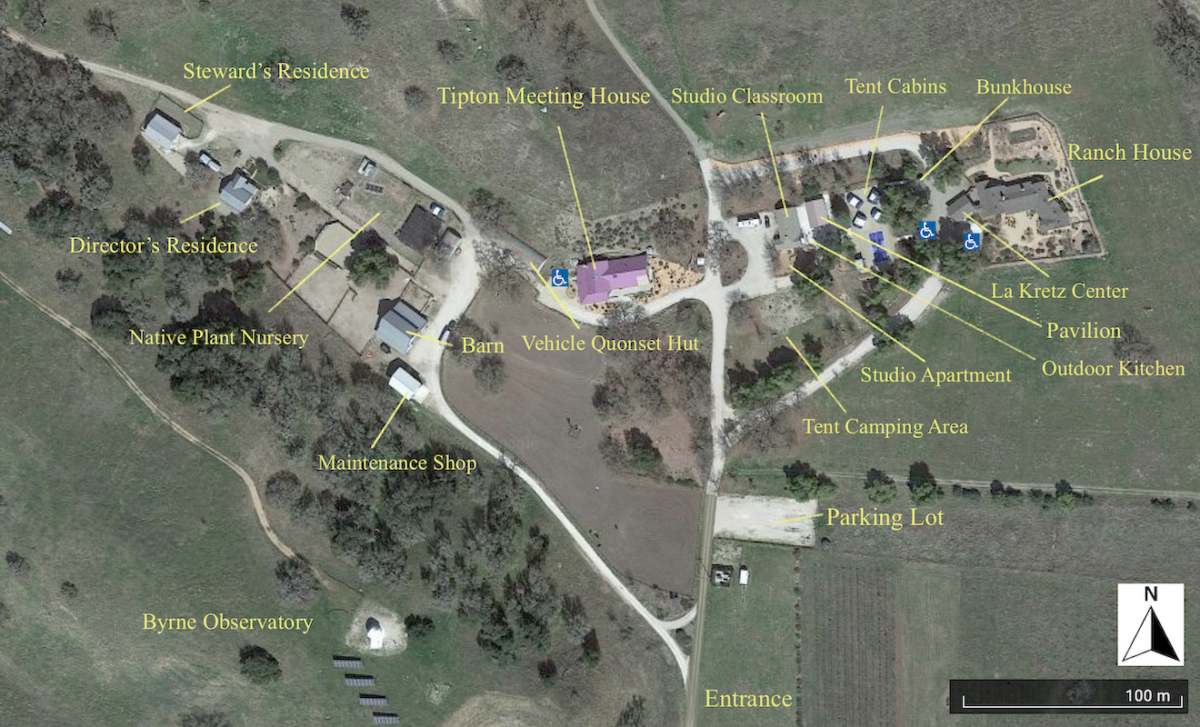
- Stop by Tipton (big blue roofed building) and sign in and sign out using the computer kiosk in the lobby.
- Please make sure everyone has signed a Waiver. If not, paper waivers are available at check in.
- If you have reserved overnight housing, you may park next to your building. If not, please park in the parking lot.
- Guests may not invite other guests. Only people listed on the approved Visit are allowed on property.
- Let reserve staff know where your research site(s) are located by logging them in Wildnote. Ask reserve staff to borrow an ipad to log your coordinates.
- Charge and carry a cell phone. If you are going to be going far into the Reserve, carry an emergency GPS device.
- Carry a fire extinguisher during fire season (June-December). Please bring your own or ask us to borrow one.
- Keep vehicles on established roadways. Check with Reserve staff and the Sedgwick map about your intended route, and check the map in the lobby for road closures. Ensure you have the proper vehicle for the locations you plan to go.
- Leave gates as you find them (e.g., if closed and locked, close and lock it after passing). There may be cows on the Reserve, it is extremely important to protect research sites and grazer investment that you close the gates behind you.
- Let reserve staff know if you see anything broken or unusual out in the Reserve.
- Review our Code of Conduct.
- Users are responsible for cleaning the facilities. Please see Cleaning Checklist.
Invoices will be emailed to the indicated person on the application after your visit. Amenities will be charged as they appear on your reservation. Let us know if you used different facilities than were on your RAMS reservation.
The following payment options are available.
- CAMPUS OR INTERCAMPUS RECHARGE: Please email your complete payment account string to admin@nrs.ucsb.edu.
2. CREDIT CARD: Please visit https://nrs.ucsb.edu/pay-your-invoice/ to make a secure payment. Or visit the UCSB NRS website at https://nrs.ucsb.edu/visiting/ and click on the “Pay your invoice” button.
3. CHECK: Please make your check out to “UC Regents, University of CA”.
Tax ID: Regents, University of CA, 95-6006145
Please add the Reserve Name and INVOICE # in the check notes field and mail to:
UCSB Natural Reserve System
MSRB 520, Mail Code: 6150
Santa Barbara, CA 93106-6150
4. ELECTRONIC PAYMENTS:
Please contact us at admin@nrs.ucsb.edu if you would like to initiate an electronic payment or wire transfer. You will be sent instructions on how to complete the process in order for the payment to reach us correctly.
- Mention Sedgwick Reserve in your manuscripts and send us your published research! We keep records of published work since the 1980s on Zotero
- Use the UCSB NRS GitHub repository for research code
- Tag us in social media on Instagram and Facebook
- Inform Sedgwick staff when projects are soon to be completed